Byzantinisches Reich |
|
 |
|
 |
 |
|
|
|
|
| Übersicht – Contents: | |
Diese Seite ist Teil des Projektes
Byzantinisches Reich |
|
|
|
|
|
|
|
|
|
| Übersicht – Contents: | |
Flaggen – Flags: |
|
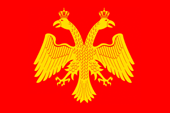 |
13.-15. Jhd./century, Flagge des Byzantinischen Reichs – flag of the Byzantian Empire, Quelle/Source, nach/by: Die Welt der Flaggen, Flags of the World   |
 |
13.-15. Jhd./century, angebliche Kriegsflagge des Byzantinischen Reichs – alleged war flag of the Byzantine Empire, Quelle/Source, nach/by: Die Welt der Flaggen, Flags of the World
|
 |
13.-15. Jhd./century, angebliche Standarte des Kaisers – alleged standard of the Emperor, Quelle/Source, nach/by: Die Welt der Flaggen, Flags of the World
|
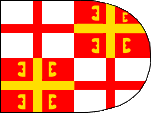 |
13.–15. Jhd./century, angebliche Standarte des Kaisers bzw. der Kaiserfamilie – alleged standard of the Emperor or the Imperial Family, Quelle/Source nach/by: Die Welt der Flaggen, Flags of the World
|
 |
|
Bedeutung/Ursprung der Flagge – Meaning/Origin of the Flag: |
|
|
|
| Das Symbol des Byzantinischen Kaiserreiches war ein goldener doppelköpfiger Adler auf rotem Grund. Als Reichsflagge fand dieses Symbol seit dem 11. Jahrhundert weite Verbreitung. Rot und Gelb sind gut erklärbar, es sind die Farben der Stadt Rom und den Römischen Reichs, was eine übliche Bezeichnung des Byzantinischen Reichs als "Zweites Rom" oder "Oströmisches Reich" gut nachvollziehen lässt. In der Praxis wurde die Flagge mit dem Adler häufig um weitere Symbole ergänzt, so etwa die Symbolik des Herrscherhauses oder Christusmonogramme, auch wurde der Adler golden eingekreist. In Kriegszeiten wurde der Adler angeblich schwarz auf Rot abgebildet. Die Kaiser aus dem Haus der Palaiologen hatten auch persönliche Standarten. Einige Quellen erwähnen hier neben der roten Adlerflagge auch eine goldene Standarte mit einem schwarzen Adler. Die Form des Adlers wird nicht geregelt gewesen sein, jedoch dürfte der Adler mit Schwert und Reichsapfel (Weltkugel) eine spätere Form darstellen, die von der Orthodoxen Kirche verwendet wurde und wird (vergleiche Athos, Hagion Oros). Eine Standarte zeigte die Symbolik der Familie herrschenden Dynastie. Das waren die Paläologen (Palaiologen). Sie kombinierten in ihrer Standarte das Georgskreuz mit einem goldenen Kreuz, das in seinen Winkeln vier Feuerstähle enthält. Dieses Symbol wird heute noch von Serbien verwendet, und hat seinen Ursprung wahrscheinlich in der Heraldik des Ordens vom Goldenen Vlies, es könnten auch viermal die griechischen Buchstaben "B" sein, was als "Baleologen" ausgelegt werden kann, aber auch als viermal den griechischen Buchstaben "V", als Initialen des griechischen Spruchs: Βασιλευς Βασιλεων Βασιλευων Βασιλευσιν (Vasilevs Vasileon Vasilevon Vasilevsin → "König der Könige, herrschend über Könige"). Insgesamt fällt es schwer die Fahnen und Banner des Byzantinischen Kaiserreiches in ein heute übliches Flaggensystem zu pressen. Es gab einfach noch keine Regelungen wie wir sie heute kennen. |
The symbol of the
Byzantine Empire was a golden double-headed eagle on a red background. This
symbol became widely used as the imperial flag from the 11th century
onwards. The choice of red and gold is easily explained: they are the
colours of the city of Rome and the Roman Empire, which helps to explain why
the Byzantine Empire was commonly referred to as the 'Second Rome' or 'Eastern Roman Empire'. In practice, the flag bearing the eagle was often supplemented with additional symbols, such as the emblems of the ruling dynasty or Christograms. The eagle was also sometimes depicted within a golden circle. In times of war, the eagle was reportedly depicted in black on a red background. The emperors of the Palaiologos dynasty also had personal standards. Some sources mention, alongside the red eagle flag, a golden standard featuring a black eagle. The form of the eagle was not regulated, but the eagle with a sword and imperial orb (globe) is likely to represent a later form used by the Orthodox Church (compare Athos, Hagion Oros). One standard displayed the symbolism of the ruling dynasty. These were the Palaiologos. Their standard combined the Cross of St. George with a golden cross, the corners of which feature four flint stones. This symbol is still used by Serbia today and probably has its origins in the heraldry of the Order of the Golden Fleece; it could also represent the Greek letter 'B' four times, which can be interpreted as 'Baleologs', or the Greek letter 'V' four times, as the initials of the Greek phrase: Βασιλευς Βασιλεων Βασιλευων Βασιλευσιν (Vasilevs Vasileon Vasilevon Vasilevsin → "King of Kings, ruling over kings"). Overall, it is difficult to fit the flags and banners of the Byzantine Empire into a modern flag system. There were simply no regulations as we know them today. |
| Quelle/Source: Die Welt der Flaggen, Flags of the World | |
|
|
Landkarte – Map: |
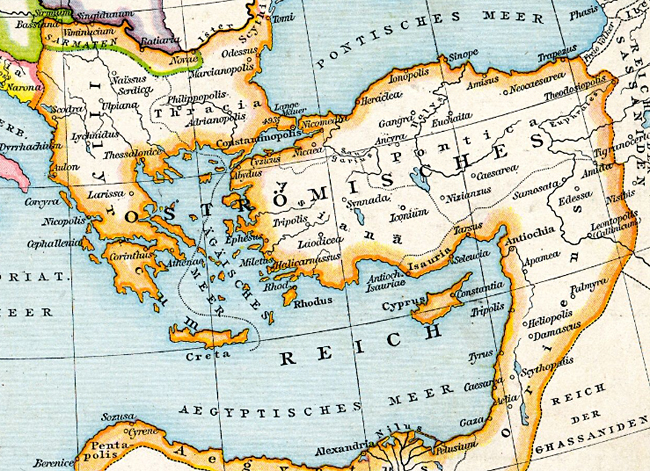
Das Byzantinische Reich im 5. Jahrhundert – The Byzantine Empire in the 5th century: |
|
Zahlen und Fakten – Numbers and Facts: |
|
|
|
|
|
|
|
| Quelle/Source:
Atlas zur Geschichte,
Weltgeschichte |
|
|
|
Geschichte: |
|
|
395 · Teilung des Römischen Reiches in Oströmisches und Weströmisches Reich 399–401 · Abwehr der Goten 531–562 · Krieg gegen das Perserreich 533–534 · Eroberung des Wandalenreichs 535–554 · Eroberung des Ostgotenreichs 568 · Verlust von Oberitalien an die Langobarden 627 · siegreicher Krieg gegen das Perserreich 642–643 · arabische Einfälle 718 · Abwehr der Araber 1081–1185 · Abwehr der Petschenegen 1204–1261 · Lateinisches Kaiserreich von Konstantinopel, damit Aufsplitterung von Byzanz in das Kaiserreich Nikaia, das Kaiserreich Trapezunt und das Despotat Epirus 1261 · Rückeroberung von Konstantinopel 1453 · Eroberung von Konstantinopel durch die Türken (Osmanisches Reich) 1461 · Eroberung von Trapezunt durch die Türken |
|
|
|
History: |
|
|
395 · partition of the Roman Empire into East Roman and West Roman Empire 399–401 · repulse of the Gotes 531–562 · war against the Persian Empire 533–534 · conquest of the Wandalic Empire 535–554 · conquest of the East Gotic Empire 568 · loss of upper Italy to the Langobardes 627 · victorious war against the Persian Empire 642–643 · Arabian invades 718 · repulse of the Arabs 1081–1185 · repulse of the Petscheneges 1204–1261 · Latin Empire of Konstantinopel, therewith shattering of Byzanz into the Empire of Nicaea, the Empire of Trebizond and the Despotate of Epirus 1261 · re-conquest of Konstantinopel 1453 · conquest of Konstantinopel by the Turks (Ottoman Empire) 1461 · conquest of Trapezunt by the Turks |
| Quelle/Source: Atlas zur Geschichte, Weltgeschichte |
|
Ursprung des Landesnamens – Origin of the Country's Name: |
|
|
|
| Das Land ist in der Geschichtsschreibung unter vielen Namen zu finden: Byzantinisches Reich, Byzanz, Oströmisches Reich, Ostrom, Romäisches Reich. Der Name des Landes geht auf die Teilung des Römischen Reiches im Jahre 395 in ein Oströmisches und ein Weströmisches Reich zurück. Schon dessen Landesnamen geht auf eine Ortschaft zurück, die Stadt Rom. Das Weströmische Reich ging relativ schnell unter, und zwar 476 mit der Absetzung des letzten römischen Kaisers Romulus Augustulus, bzw. 486 mit Untergang des Reiches des Syagrius als letzten römischen Statthalter. Das Oströmische Reich bestand noch viele Jahrhunderte und da das Römische Reich mit Westrom quasi untergegangen war, wurde die Hauptstadt des Oströmischen Reiches – Byzanz – der Mittelpunkt der römischen Welt, als sprichwörtliches Zweites Rom. Das wird auch im Selbstverständnis des Landes deutlich, das sich selber Basileía Rhōmaíōn (Imperium Romanum) nannte, und zwar in der Landsprache Griechisch. Die Einwohner verstanden sich selber auch nicht als Griechen, sondern als "Romäer", also Römer. Von einigen Geschichtsschreibern, Chronisten und Zeitzeugen wurde das Land ebenfalls nach der Hauptstadt benannt, woher der Name Byzantinisches Reich kommt, auch wenn die Stadt ab dem Jahre 337, nach dem Tod von Kaiser Konstantin, in "Constantinopolis" umbenannt wurde. Der Name Konstantinopel blieb für die Stadt bis zur Eroberung durch die Türken im Jahre 1453 erhalten, welche die Stadt in "Istānbūl" umbenannten, auch wenn in einem Übergangszeitraum "Kostantiniyye" weiter verwendet wurde. |
The country can be found
in historiography under many names: Byzantine Empire, Byzantium, Eastern
Rome, East Roman Empire, Eastern Roman Empire, Romëic Empire, Byzantine Empire.
The name of the country goes back to the partition of the Roman Empire in 395 into an Eastern Roman and a Western Roman Empire. Even this country's name goes back to a locality, the city of Rome. The Western Roman Empire fell relatively quickly, in 476 with the deposition of the last Roman emperor Romulus Augustulus, and in 486 with the fall of the Empire of Syagrius as the last Roman governor. The Eastern Roman Empire still existed for many centuries and because the Roman Empire with Western Rome had almost perished, the capital of the Eastern Roman Empire – Byzantium – became the center of the Roman world, as the proverbial Second Rome. This is also to see in the self-image of the country, which called itself Basileía Rhōmaíōn (Imperium Romanum), in the local language Greek. The inhabitants did not see themselves as Greeks either, but as "Romëans", i.e. Romans. Some historians, chroniclers and contemporary witnesses also named the country after the capital, where the name Byzantine Empire comes from, even if the city was renamed in "Constantinopolis" in the year 337, after the death of Emperor Constantine. The name Constantinople was retained for the city until it was conquered by the Turks in 1453, who renamed the city in "Istānbūl", even though "Kostantiniyye" was still used during a transitional period. |
| Quelle/Source: Wikipedia (D), Volker Preuss | |
|
|