Symbole des Templerordens |
| Symbols of the Knights Templar |
 |
von/by Volker Preuß & Ronald Preuß |
Diese Seite ist Teil des Projektes
Symbole des Templerordens |
| Symbols of the Knights Templar |
|
von/by Volker Preuß & Ronald Preuß |
Bei wahrscheinlich keinem
anderen Ritterorden stellt sich so sehr die Frage nach der Flagge. Der Orden
ist sehr bekannt und sehr beliebt, seine Geschichte und seine Ritter spielen
ein große Rolle in Literatur und Film. Der Wunsch eine Flagge des
Templerordens zu besitzen ist nachvollziehbar. Aber wie sah die Flagge bzw.
das Banner aus? Welche Rolle spielt das rote Templerkreuz? |
Probably no other order of knights raises the question of its flag to such
an extent. The order is very well known and very popular, and its history
and knights play a major role in literature and film. The desire to own a
flag of the Knights Templar is understandable. But what did the flag or
banner look like? What role does the red Templar cross play? As is so often the case, the sources are very scarce and there are very different motifs or variants in often idealised depictions. There was no standardisation at that time, no service regulations or paragraphs governing such matters. Not even the rules of the Templars describe a flag, at least not in the first version of the rules from 1129, which only mentions a "two-coloured banner" several times. But which two colours? The motif of the seal, which was also not always uniform, was not transferred to the flags. It did not show a coat of arms, but usually two knights on a horse, which was supposed to symbolise the "poor knights of Christ", not all of whom – as the seal would have us believe – even had their own horse, although in reality the order was very wealthy. Even this seal differed from commandery to commandery, and some used other seal images. Of course, there were no central production facilities, not for seals, not for shields, not for flags or banners. According to the rules, the knights received their clothing and, in some cases, their equipment from the Order, and a certain degree of uniformity was certainly ensured. For knights, the white tunic with the red Order cross on the front and back and the white cloak with the cross on the left shoulder was prescribed (from 1147). For serving brothers, a black surcoat with the red order cross on the front and back and a brown cloak were prescribed. Even this was not always possible in practice, so that serving brothers wore what was most readily available, namely brown. The shields were also not uniform; each had its own model, depending on its purpose, as a shield for a horseman or a foot soldier, depending on the preferences of the time, the length of the opponents' swords, or depending on the optimisation of one's own weapons or fighting technique. Another contributing factor was the region of Europe and the craftsman who made the shield. In feudalism, after the emergence of heraldry, it was customary for the image of the knight's or feudal lord's coat of arms to be displayed on the shield. However, when the Order was founded (1118), heraldry did not yet exist; it only emerged in the second half of the 12th century. Furthermore, upon joining the Order, personal matters and affairs no longer played a role. According to the rules, it was even forbidden to decorate shields and lances with decorative covers; any decoration was prohibited. How were the shields designed? And what did the Order's coat of arms look like? In feudalism, after the development of heraldry, it was customary for knights to receive their coats of arms from the king, or at least from their feudal lord, i.e. the person whose fief they had taken and whose vassal they had become. In very rare cases did he himself have any influence on this. This was done by experts, often heralds, if such an office existed. The coat of arms was thus established and its symbolism was also transferred to seals if necessary. Which feudal lord is said to have granted the Order a coat of arms? The Order was a voluntary association of knights and their serving brothers and was subject only to the Pope, but not as an enfeoffed body. In certain cases, the popes of that time liked to hand over banners to show the blessing of the Pope to some dignitaries of their time. For example, William the Conqueror, Duke of Normandy, had also received a banner from the Pope for the conquest of England and the establishment of his kingdom. During the Crusades, the Pope's banners were also carried, which had been awarded to the respective armies or contingents. However, this was not the main focus for the Knights Templar and their symbolism. It was not created "from above" and brought into being with great fanfare, but was founded in 1118 and had to fight for its status step by step until the clergy and ultimately the Pope accepted the Order. It was not until 1139 that the Order was placed directly under the Pope and developed a strong autonomy. But it never had a coat of arms. Even the founder of the Order – Hugo de Payns – did not have a coat of arms, not even in his function as Grand Master (1119–1136); in his time, personal coats of arms did not yet exist. Let's summarise the questions that arise from the facts and try to find a solution: • What did the seal of the Order look like? • What did the coat of arms of the Order look like? • What did the shields of the Order look like? • What role does the red Templar cross play? • What did the flag or banner of the Order look like? |
 |
Wie sah das Siegel des Ordens aus? |
What did the Order's seal look like? |
Im Mittelalter konnten nur wenige Menschen lesen. Deshalb brauchte jede Institution ein eindeutiges Siegel, das Urkunden beglaubigte. Das Templer‑Siegel ist eines der bekanntesten Symbole des Mittelalters, es war die offizielle Identität des Ordens – vergleichbar mit einem modernen Firmenlogo. Es diente als "Unterschrift" und zeigt je nach Epoche unterschiedliche Motive. Die wichtigsten Templer‑Siegel – verwendet ab der Mitte des 12. Jahrhunderts waren: 1.) Das berühmte Doppeltreiter‑Siegel, es zeigt zwei Ritter auf einem Pferd und die Umschrift: SIGILLUM MILITUM CHRISTI ("Siegel der Soldaten Christi"). Es sollte die Armut und Brüderlichkeit des Ordens symbolisieren (zwei Ritter teilen sich ein Pferd) und war ein Hinweis auf die ursprüngliche Bezeichnung des Ordens "Arme Ritterschaft Christi". Dieses Siegel ist erst nach Hugo von Payns sicher belegt, stammt also nicht aus der Gründungszeit des Ordens. 2.) Das Agnus‑Dei‑Siegel (Lamm Gottes), es zeigt das Lamm Gottes mit einer Kreuzfahne und soll Christus als Opferlamm symbolisieren und wurde oft für spirituelle oder liturgische Dokumente genutzt. 3.) Regionale und funktionale Varianten, denn der Orden besaß zahlreiche Siegel, darunter: Siegel einzelner Komtureien, Siegel der Provinzmeister, Siegel für Finanzgeschäfte, Siegel für Gerichtsurkunden. Viele zeigen Varianten des Kreuzes oder architektonische Motive. Von Hugo von Payns ist kein kein persönliches Siegel überliefert, die frühesten bekannten Templer‑Siegel stammen aus der Zeit nach seinem Tod, immer verwendet als kollektive Siegel, nie eine Einzelperson repräsentierend. |
In the Middle Ages, only a few people could read. Therefore, every
institution needed a unique seal to authenticate documents. The Templar seal
is one of the most famous symbols of the Middle Ages; it was the official
identity of the Order – comparable to a modern company logo. It served as a
"signature" and features different motifs depending on the era. The most
important Templar seals – used from the mid-12th century onwards – were: 1.)
The famous double horseman seal, showing two knights on one horse and the
inscription: SIGILLUM MILITUM CHRISTI ("Seal of the Soldiers of Christ"). It
was intended to symbolise the poverty and brotherhood of the Order (two
knights sharing one horse) and was a reference to the Order's original name,
"Poor Knights of Christ". This seal is only reliably documented after the
time of Hugo de Payns, so it does not date from the founding period of the
Order. 2.) The Agnus Dei seal (Lamb of God), showing the Lamb of God with a
cross banner, symbolising Christ as the sacrificial lamb, was often used for
spiritual or liturgical documents. 3.) Regional and functional variants, as
the Order possessed numerous seals, including: seals of individual
commanderies, seals of provincial masters, seals for financial transactions,
seals for court documents. Many show variations of the cross or
architectural motifs. No personal seal of Hugo de Payns has survived; the
earliest known Templar seals date from after his death and were always used
as collective seals, never representing an individual. |
|
|
|
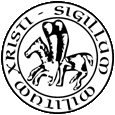 Siegel des Templerordens – Seal of the Order of the Templars |
|
|
|
Wie sah das Wappen
|
What did the coat of arms of the Knights Templar look like? |
Ein offizielles Wappen im
heraldischen Sinn hatte der Templerorden nie, aber einige Symbole wurden so
konsequent verwendet, dass sie als Wappen des Ordens gelten, bzw. etwa ab
der zweiten Hälfte des 12. Jahrhunderts als Heroldsstücke (Templerkreuz) in
Familienwappen von Adligen ergänzt wurden, wenn sie Mitglieder des Ordens
geworden waren. Da wären: 1.) Das rote Templerkreuz auf Weiß, ab 1147 auch
auf der Kleidung getragen – das wohl bekannteste Symbol des Ordens – wurde
mit Sicherheit auf das eine oder andere Schild aufgemalt. Die Folge war,
dass diese Symbolik so als Wappen wahrgenommen auch verwendet wurde, aber
sicherlich nicht zur Zeit des Ordens selber, sondern in den nachfolgenden
Jahrhunderten. 2.) Das Siegel des Ordens. Es zeigte meist zwei Ritter auf
einem Pferd, als Symbol der Armut und brüderlichen Gemeinsamkeit. 3.) Das
Agnus Dei (Lamm Gottes), ein Lamm mit einer Kreuzfahne, es wurde ebenfalls
als Siegel verwendet. |
The Knights Templar never had an official coat of arms in the heraldic
sense, but some symbols were used so consistently that they are considered
the coat of arms of the order, or, from the second half of the 12th century
onwards, were added as heraldic pieces (Templar cross) to the family coats
of arms of nobles who had become members of the order. These were: 1.) The red Templar cross on white, also worn on clothing from 1147 onwards – probably the most famous symbol of the Order – was certainly painted on one or other shield. As a result, this symbolism was perceived and used as a coat of arms, but certainly not at the time of the Order itself, but in the centuries that followed. 2.) The seal of the Order. It usually showed two knights on a horse, symbolising poverty and brotherly unity. 3.) The Agnus Dei (Lamb of God), a lamb with a cross flag, was also used as a seal. However, there is and always has been a connection between coats of arms and shields, which must have gradually developed into heraldic principles. Strictly speaking, as soon as a symbol such as an order cross is painted on a shield, it becomes a coat of arms. The term "symbol" does not refer to a personal emblem. Such symbols have existed since shields first appeared. A coat of arms must be a symbol of a lasting nature that transcends a single person. Presumably, this was already understood at the time when the order cross was painted on the shield, in the early days of heraldry. |
|
Wie sahen die Schilde des Ordens aus? |
What did the Order's shields look like? |
Das Bild des Wappens des Feudalherren oder Ritters wurde ab der zweiten Hälfte des 12. Jahrhunderts meist auf sein Schild übertragen, damit war es nicht nur Schutz sondern auch eine Art "Ausweis" und Symbol der feudalen Macht im zugewiesenen Lehensgebiet. Der Templerorden hatte, wie wir inzwischen wissen, kein Wappen, aber immerhin ab 1147 das Ordenskreuz. Wenn man sich Illustrationen in den Handschriften dieser Zeit anschaut, sieht man immer unterschiedliche Bemalungen auf den Schilden, oder sie waren unbemalt und zeigten von der Mitte des Schildes ausgehende, eiserne Verstrebungen. Das wird der Wahrheit sehr nahe kommen. Wie wir wissen, war jeglicher Schmuck, ausdrücklich an Lanze und Schild verboten, zumindest als schmückender Überzug. Das man sich nicht immer und nicht einheitlich an die Ordensregeln gehalten haben wird, ist sicherlich auch klar. Insofern dürften Bemalungen vorgekommen sein. Was man auf den alten Abbildungen häufig als bemalte Schilde sehen kann, sind weiße Schilde, deren oberes Drittel (Schildhaupt) schwarz war. Seltener sieht man das Ordenskreuz auf Weiß. Die Frage ist, ob die Bemalung einheitlich gewesen ist, man kann aber sicherlich davon ausgehen, dass das manchmal angestrebt war. Man muss sich vorstellen, dass die Ritter aus den unterschiedlichsten, manchmal weit voneinander entfernten Komtureien und Templerprovinzen (Balleien, Präzeptoreien) für eine militärische Aktion zusammengerufen wurden und es ist vorstellbar, dass die eventuell in jeder Komturei oder auch Provinz angestrebte Einheitlichkeit im Gesamtbild der militärischen Einheit eine Vielfalt dargestellt haben muss, nicht nur in der Nationalität, Sprache und Kultur, sondern folglich auch bei den Schilden, bei Details der Kleidung, der Bewaffnung, der Helme und auch bei der Form des Ordenskreuzes. Bei der Gesamtbetrachtung ist es wichtig, dass man sich nicht von Darstellungen irritieren lässt, die auf Grund des großen Interesses am Thema in literarische Quellen oder Webseiten im Internet Einlass gefunden haben, auch wenn es sich dabei um historische Abbildungen oder Beschreibungen handelt. Der Orden wurde schon 1312 aufgelöst. Jede geschichtliche Epoche hat das Thema Templer aufgriffen und reichlich mit Geschichten und Bildmaterial aufgefüllt, so dass z.B. das Ordenskreuz geschmacklichen und zeitgeistigen Orientierungen unterworfen war, je nach dem wann das Bild gemalt oder der Text verfasst worden ist. Das Betrifft z.B. auch großartig ausgeführte Wappen, die sich finden lassen, deutliche Spuren des 18. Jahrhunderts tragend, gerade auch durch den Einzug der Templer in die Freimaurerei. So etwas hat es nie gegeben, wurde künstlerisch angefertigt und nachträglich den Templern zugeschrieben. |
From the second half of the 12th century onwards, the image of the feudal
lord's or knight's coat of arms was usually transferred to his shield, so
that it was not only a means of protection but also a kind of "identity
Card" and symbol of feudal power in the assigned fiefdom. As we now know,
the Knights Templar did not have a coat of arms, but they did have the
Order's cross from 1147 onwards. If you look at illustrations in manuscripts
from this period, you will always see different paintings on the shields, or
they were unpainted and showed iron struts radiating from the centre of the
shield. This is very close to the truth. As we know, any decoration was expressly forbidden on lances and shields, at least as a decorative covering. It is also clear that the rules of the Order were not always adhered to uniformly. In this respect, painting may have occurred. What can often be seen as painted shields in old illustrations are white shields with the upper third (shield head) painted black. More rarely, the Order's cross can be seen on white. The question is whether the painting was uniform, but it can certainly be assumed that this was sometimes the aim. One must imagine that knights from a wide variety of commanderies and Templar provinces (balleies, preceptories), sometimes far apart, were called together for military action, and it is conceivable that the uniformity that may have been sought in each commandery or province must have represented diversity in the overall picture of the military unit, not only in terms of nationality and language and culture, but also in the shields, details of clothing, armament, helmets and even the shape of the Order's cross. When looking at the big picture, it is important not to be misled by depictions that have found their way into literary sources or websites due to the great interest in the subject, even if they are historical illustrations or descriptions. The Order was dissolved as early as 1312. Every historical epoch has taken up the subject of the Templars and filled it with stories and images, so that, for example, the Order's cross was subject to taste and zeitgeist orientations, depending on when the picture was painted or the text written. This also applies, for example, to magnificently executed coats of arms that can be found bearing clear traces of the 18th century, particularly due to the Templars' entry into Freemasonry. Such things never existed; they were artistically crafted and subsequently attributed to the Templars. |
|
|
|
   Source: muculmanoeportugues.blogspot.com Chronica Matthäus Paris, London, Brit. Context.Scope.Library MS Royal 14 C VII fol 42v |
|
|
|
Welche Rolle spielt das rote Templerkreuz und wie sah es eigentlich aus? |
What role did the red Templar cross play, and what did it actually look like? |
Als der Templerorden um
1119/1120 gegründet wurde, hatten die Ritter kein rotes Kreuz als Zeichen.
Sie trugen zwar den charakteristischen weißen Mantel, doch ohne das später
so bekannte rote Tatzenkreuz. Das rote Kreuz wurde erst 1147 während des
Zweiten Kreuzzugs offiziell eingeführt, als Papst Eugen III. dem Orden
genehmigte, ein rotes Kreuz ihren weißen Mänteln zu tragen. Das ist in
der Ordensüberlieferung und späteren Chroniken bestätigt. Das Kreuz sollte
Martyrium und Opferbereitschaft symbolisieren und den militärisch-religiösen
Auftrag unterstreichen. Die Farbe Rot wird in der kirchlichen Symbolik
traditionell mit dem Blut Christi, Märtyrertum und Opfermut verbunden. Für
einen militärischen Orden, der bereit war, für seinen Glauben zu sterben,
war das sehr passend. Wer auch immer auf die Idee mit dem roten Kreuz kam,
der Orden selbst oder Bernhard von Clairvaux – ein großer Förderer des
Ordens – war auf jeden Fall vom Ersten Kreuzzug (1096–1099) inspiriert, denn
schon die Teilnehmer des Ersten Kreuzzuges nähten sich ein rotes Kreuz auf
die linke Schulter. Immerhin soll es Bernhard von Clairvaux selbst gewesen
sein, der 1147 bei Papst Eugen III. durchsetzte, dass die Templer das rote
Tatzenkreuz dauerhaft auf ihrem weißen Mantel tragen durften. |
When the Knights Templar were founded around 1119/1120, the knights did not
have a red cross as their symbol. They wore their characteristic white
cloaks, but without the red pattée cross that later became so famous. The
red cross was not officially introduced until 1147 during the Second
Crusade, when Pope Eugene III granted the order permission to wear a red
cross on their white cloaks. This is confirmed in the Order's tradition and
later chronicles. The cross was intended to symbolise martyrdom and
sacrifice and to underline the military-religious mission. In ecclesiastical
symbolism, the colour red is traditionally associated with the blood of
Christ, martyrdom and sacrificial courage. This was very fitting for a
military order that was prepared to die for its faith. Whoever came up with the idea of the red cross, whether it was the Order itself or Bernard of Clairvaux – a great supporter of the Order – was in any case inspired by the First Crusade (1096–1099), because the participants in the First Crusade already sewed a red cross onto their left shoulder. After all, it is said to have been Bernard of Clairvaux himself who persuaded Pope Eugene III in 1147 to allow the Templars to wear the red pattée cross permanently on their white cloaks. It is interesting to note that no single binding form was ever specified. It simply had to be red and clearly visible. The most common design was the paw cross. It is also called a pattee cross. This term comes from the French language and literally means "foot cross" (actually an animal's foot). The main feature is that the arms of the cross are narrow in the middle and usually spread out in a curved or straight line to a wide edge. This cross shape first appears in early medieval art, in a cathedral treasure from Monza Cathedral, which was donated by the Lombard queen Theodelinda (also known as Theudelinde, 570–627). In detail, the design of the shape can vary considerably due to regional, fashionable or contemporary influences, with straight or concave arms and also indentations at the ends. Similarly, but less frequently, the cross was depicted as a Latin cross with straight arms. The cross was understood exclusively as the sign of the religious vow. (Source: identifymedals.com) |
|
|
|


The Cross of Theudelinde Quelle/Source: newliturgicalmovement.org |
|
|
|
Wie sah die Flagge bzw. das Banner
|
What did the flag or banner
|
Das Banner des Templerordens – es wurde "Beaucéant" genannt – war schwarz‑weiß geteilt (horizontal geteilt, oben schwarz, unten weiß) und es trug kein rotes Templerkreuz. Das rote Tatzenkreuz der Templer war ausschließlich ein Mantel- und Ordenssymbol. Es taucht auf keiner authentischen mittelalterlichen Abbildung des Banners auf. Der Grund dafür ist darin zu suchen, dass die Templer ihr Banner als Kommandozeichen auf dem Schlachtfeld betrachteten und es sollte vom Ordenskreuz unterschieden sein, denn das Kreuz wurde ausschließlich ein Zeichen des Ordensgelübdes verstanden und nicht als Symbol einer militärischen Einheit. Die Farbe Schwarz stand für Strenge, Respekt und Kampfeswille, die Farbe Weiß stand für Reinheit, Gnade und Bruderliebe. Mehrere Ordensregeln und Kommentare aus dem 13. Jahrhundert zitieren dazu folgenden Symbolspruch: "Schwarz gegenüber den Feinden, Weiß gegenüber den Freunden". "Beaucéant" (auch "Beauséant") war auch der Schlachtruf des Ordens. Späteren Quellen zeigen das Banner mit der Aufschrift "Beauseant". Das könnte es gegeben haben, allerdings erst ab dem 13. und 14. Jahrhundert. |
The banner of the Knights Templar – known as the "Beaucéant" – was divided
into black and white (horizontally divided, black above, white below) and
did not bear the red Templar cross. The red pattée cross of the Knights
Templar was exclusively a symbol of the Order and coat decoration. It does
not appear on any authentic medieval depictions of the banner. The reason
for this is that the Templars regarded their banner as a command symbol on
the battlefield and it had to be distinguished from the Order's cross,
because the cross was to understood exclusively as a sign of the Order's vow
and not as a symbol of a military unit. The colour black stood for severity,
respect and fighting spirit, while white stood for purity, mercy and
brotherly love. Several order rules and commentaries from the 13th century
quote the following symbolic saying: "Black towards enemies, white towards
friends". "Beaucéant" (also "Beauséant") was also the battle cry of the
Order. Later sources show the banner with the inscription "Beauseant". This
may have existed, but only from the 13th and 14th centuries onwards. |
|
|
|
 Source: herald.poore-house.com Chronica Maiora, Parker MS 16 fol. 142r. 1250  Source: geopop.it  Source: Reconstruction based on a description |
|
|
|
Wie könnte die Flagge der Templer heutzutage aussehen? |
What might the flag of the Knights Templar look like today? |
Aus dem oben geschriebenen lassen sich ein paar Dinge ableiten, die uns dem Ziel einer Flagge der Templer näherbringt, und zwar so wie man sie heutzutage verwenden müsste. |
From the above, we can deduce a few things that bring us closer to the goal of a flag for the Knights Templar, as it would need to be used today. |
| 1. Möglichkeit | 1st Possibility |
|
|
|
In seiner Urform, als Feldzeichen, war das Banner eine eher lange als breite Fahne, zwei Farben, Schwarz über Weiß. |
In its original form, as a field sign, the banner was a flag that was longer than it was wide, with two colours, black over white. |
 |
|
|
|
|
Das könnte man in ein modernes Format bringen, 3:5, hochkant, und schon mal so hissen. |
This could be converted into a modern format, 3:5, portrait, and be hoisted as is. |
   |
|
|
|
|
Und jetzt noch Querformat, wie heute fast überall üblich. |
And now landscape format, as is common almost everywhere today. |
 |
|
|
|
|
Aber wer soll das als Flagge der Templer erkennen? Sieht eher aus wie eine Signalflagge! Aber welches Signal soll gesendet werden? |
But who would recognise this as the flag of the Knights Templar? It looks more like a signal flag! But what signal is it supposed to send? |
|
|
|
In Ordnung, wir passen das noch an, jetzt wird das als Farbenflagge erkennbar. |
All right, we'll adjust it so that it's recognisable as a colour flag. |
  |
|
|
|
|
Aber was erkennen wir? Leute, die sich auskennen, werden folgendes sehen: |
But what do we see? People who are familiar with the subject will see the following: • The flag/colours of Prussia (former German federal state), • The flag/colours of East Prussia (former Prussian province), • The flag/colours of the Duchy of Lauenburg (former Prussian duchy), • The colours of the Canton of Fribourg (Freiburg) in Switzerland. |
|
|
|
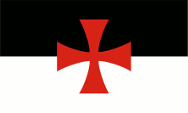
Ohne Zweifel müsste hier ein Merkmal zur Unterscheidung dazukommen, wir entscheiden uns für das Templerkreuz, und fertig: |
Without a doubt, a distinguishing feature would have to be added here. We decide on the Templar cross, and that's it: |
  |
|
|
|
| 2. Möglichkeit | 2nd Possibility |
|
|
|
Wir gehen wieder von der Urform aus, als Feldzeichen, war das Banner eine eher lange als breite Fahne, zwei Farben, Schwarz über Weiß. |
We start again from the original form, as a field sign, the banner was a flag that was longer than it was wide, two colours, black over white. |
|
|
|
|
|
|
Das könnte man wieder in ein modernes Format bringen, 3:5, hochkant, und schon mal so hissen. |
This could be converted into a modern format, 3:5, portrait, and be hoisted as is. |
|
|
|
|
|
|
Jetzt noch das Templerkreuz einfügen und schon mal so hissen. |
Now just add the Templar cross and hoist it up. |
 |
|
|
|
|
Und jetzt noch Querformat, wie heute fast überall üblich, und fertig: |
And now landscape format, as is common almost everywhere today, and you're done: |
 |
|
|
|
| 3. Möglichkeit | 3rd Possibility |
|
|
|
Wir wissen jetzt, dass die Templer kein Wappen hatten. Aber hatte ein Wappen in der Zeit der Heraldik nicht die Form eines Schildes? Wurde nicht das Bild was Wappens auf das Schild übertragen? Von historischen zeitgenössischen Dokumenten her wissen wir aber, das doch das eine oder ander Schild eines Templeritters bemalt gewesen sein könnte. Oben schmal in Schwarz, unten breit in Weiß. Das nehmen wir uns mal als Vorlage. |
We now know that the Knights Templar did not have a coat of arms. But in the age of heraldry, did coats of arms not take the form of a shield? Was the image of the coat of arms not transferred onto the shield? From historical contemporary documents, we know that one or two shields belonging to Knights Templar may have been painted. Narrow at the top in black, wide at the bottom in white. Let's use that as a template. |
 |
|
|
|
|
Jetzt muss noch etwas Templerisches dazu, das Ordenskreuz! |
Now we need something Templar to go with it, the Order's cross! |
 |
|
|
|
|
Das könnte man wieder in ein modernes Format bringen, 3:5, hochkant, und schon mal so hissen. |
This could be converted into a modern format, 3:5, portrait, and be hoisted as is. |
|
|
|
|
|
|
Und jetzt noch Querformat, wie heute fast überall üblich, und fertig: |
And now landscape format, as is common almost everywhere today, and you're done: |
|
|
|
|
|
| 4. Möglichkeit | 4th Possibility |
|
|
|
Wir gehen wieder von dem bemalten Schild aus, so wie wir es von historischen und zeitgenössischen Dokumenten her kennen. |
We start again from the painted shield, as we know it from historical and contemporary documents. |
|
|
|
|
|
|
Jetzt muss wieder etwas Templerisches dazu, das Ordenskreuz! |
Now we need something Templar again, the Order's cross! |
|
|
|
|
|
|
Jetzt erinnern wir uns, wie in der Frühzeit der Haraldik ein Wappenbanner hergestellt wurde (vgl. Valencia). Oben am Wappen schieben wir eine Fahnenstange durch eine oder mehrere Stoffschlaufen. |
Now let us recall how a coat of arms banner was made in the early days of heraldry (see Valencia). At the top of the coat of arms, we push a flagpole through one or more fabric loops. |
 → → |
|
|
|
|
Jetzt noch drehen ... |
Now turn it ... |
 → → |
|
|
|
|
und die Vorlage für eine Flagge ist fertig! |
and the template for a flag is ready! |
 |
|
|
|
| 5. Möglichkeit | 5th Possibility |
|
|
|
Wir gehen wieder von dem bemalten Schild aus, so wie wir es von einigen historischen und zeitgenössischen Dokumenten her kennen. |
We again assume the painted shield, as we know it from some historical and contemporary documents. |
 |
|
|
|
|
und die Vorlage für eine Flagge ist fertig! |
and the template for a flag is ready! |
 |
|
|
|
